
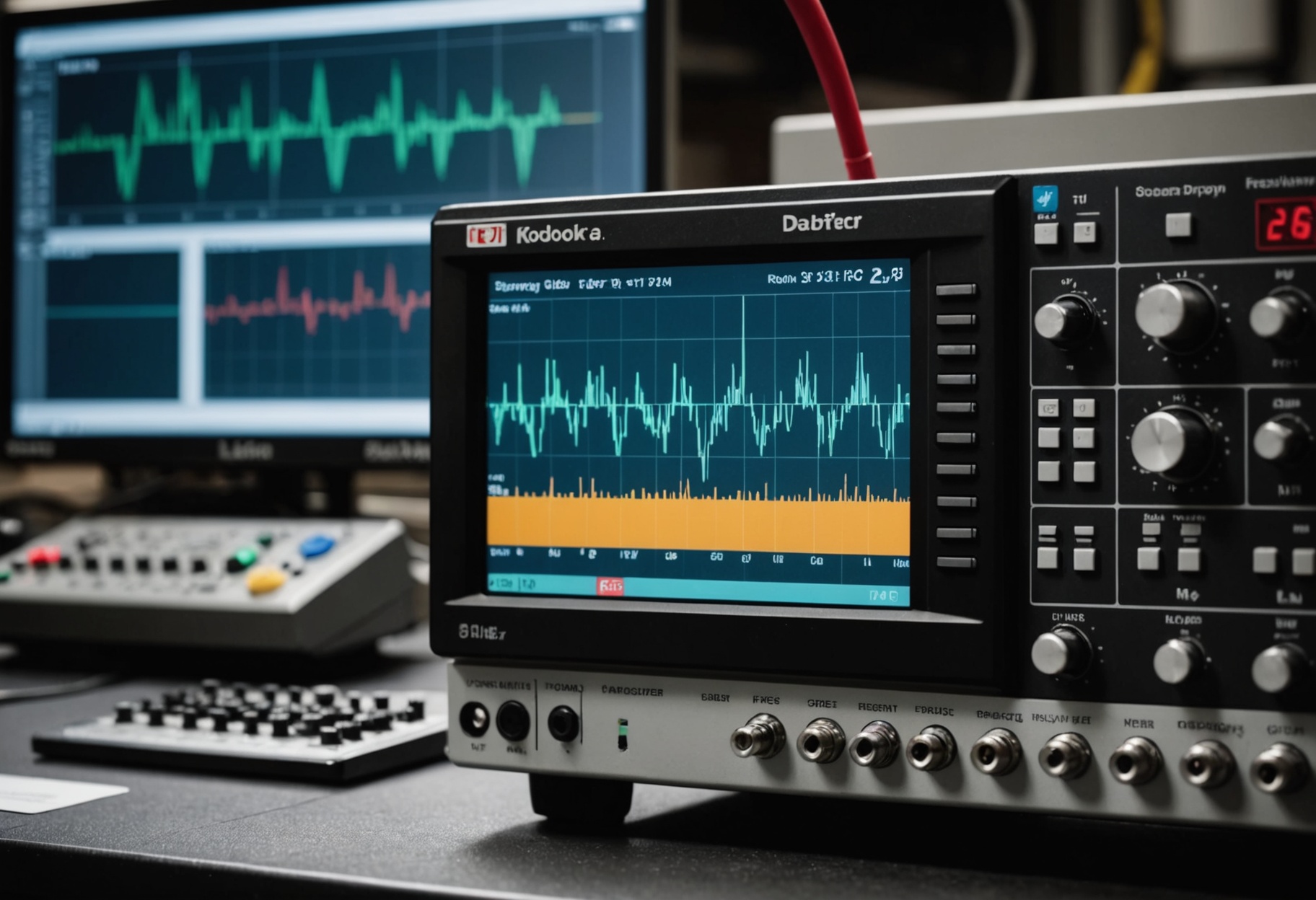
Threshold-based alarms are set high enough to avoid false positives — which means they also miss the outer race defect frequency until it is too late to plan a repair. This is not a configuration problem. It is a fundamental limitation of alarming on overall vibration level rather than on specific spectral features. The fix requires a different measurement approach, not a better alarm threshold.
How Bearings Fail and What the Spectrum Shows
Rolling element bearing failure follows a well-documented progression. In stage 1, defects are sub-surface and produce no detectable vibration. In stage 2, surface spalling begins and defect frequencies appear at low amplitude in the high-frequency range (5–20 kHz ultrasonic spectrum). In stage 3, defect frequencies are visible in the standard vibration spectrum (0–10 kHz range) and sidebands appear around running speed harmonics. Stage 4 is gross failure — the bearing is visibly damaged and generates broadband noise across the entire spectrum.
The critical window for planned maintenance intervention is stage 2 to early stage 3. At that point, a bearing replacement can be scheduled during the next planned production stop. By late stage 3 and certainly by stage 4, the failure is urgent enough to force unplanned shutdown. Most threshold-based alarms don't trigger until stage 3 or 4, because the overall vibration level in stage 2 is barely elevated above the normal operating baseline.
The Four Characteristic Defect Frequencies
Ball pass outer race frequency (BPFO), ball pass inner race frequency (BPFI), fundamental train frequency (FTF), and ball spin frequency (BSF) are calculable from bearing geometry dimensions. For a typical 6206 deep groove ball bearing running at 1,800 RPM, BPFO is approximately 87 Hz, BPFI approximately 133 Hz, FTF approximately 12 Hz, and BSF approximately 57 Hz. These values shift with shaft speed, so any monitoring system that uses fixed frequency bins rather than order-tracked analysis will miss the defect peaks when motor speed varies.
The detection challenge is that in stage 2, these defect frequency amplitudes may be only 0.02–0.05 g above the noise floor. An alarm set at 0.5 g overall (a reasonable choice to avoid nuisance trips on a press motor) will never trigger on a 0.03 g spectral peak. Only an algorithm that specifically looks for energy at the bearing defect frequency locations — relative to the background spectrum at those frequencies — can detect stage 2 reliably.
Why 1 kHz Sampling Rate Is Not Enough
The Nyquist theorem requires sampling at twice the highest frequency of interest. Detecting bearing defects in the 5–20 kHz range requires a sampling rate of at least 40 kHz. The 25.6 kHz sampling rate in EdgeRun's ER-200 sensor node covers defect detection up to 12.8 kHz — adequate for stage 2 detection on most rolling element bearings under 3,600 RPM. Many installed condition monitoring systems sample at 1–4 kHz, which covers the standard vibration range but misses the ultrasonic frequencies where stage 2 signatures live.
When a plant engineer asks us why their existing Rockwell or SKF system didn't catch a bearing failure before stage 4, the answer is almost always sampling rate combined with alarm philosophy. The hardware was designed for a different detection approach — one where the goal was catching gross mechanical failure before catastrophic damage, not identifying degradation weeks before visible failure. Asking that hardware to do early fault detection without changing the sensor or the analysis software is asking it to do something it was not designed for.
Fast Fourier Transform vs. Envelope Analysis
Standard FFT of the raw vibration waveform shows amplitude vs. frequency. Envelope analysis — also called high-frequency resonance technique — demodulates the bearing defect impulses from the high-frequency carrier signal, revealing the impacting rate as a distinct frequency peak. For stage 2 bearing faults, envelope analysis typically produces a 6–10 dB better signal-to-noise ratio than direct FFT analysis of the raw signal.
EdgeRun's onboard signal processing pipeline applies bandpass filtering around the sensor resonance frequency (typically 5–8 kHz for our accelerometer), rectification, low-pass filtering, and then FFT of the envelope signal. The result is a spectrum where bearing defect frequencies, if present, appear as clear peaks rather than subtle elevations. This four-step envelope analysis pipeline runs on the edge gateway — no cloud round-trip needed, and no dependence on the raw waveform being transmitted offsite.
The False Alarm Calibration Trap
Most plant maintenance managers who have deployed a condition monitoring system have a story about the first month: alerts were firing constantly, the maintenance team was dispatching technicians to healthy equipment, and the system was turned off or had its thresholds raised until it stopped generating noise. This is not a failure of the people or the platform — it is a natural consequence of deploying broadband threshold alarms without asset-specific baseline calibration.
Solving this by raising alarm thresholds does not improve the system. It makes it quieter, but it also makes it less sensitive to the early-stage signals that justify running the system at all. The correct solution is asset-specific anomaly detection with a calibrated baseline — so that a threshold exceedance is computed not against a global vibration limit but against the normal operating signature of that specific asset at that specific load and speed condition. As we described in our article on baseline calibration, the 14-day calibration window is the most important period in a predictive maintenance deployment.
What Frequency Resolution Determines
FFT frequency resolution is determined by the analysis window length: resolution in Hz equals the sampling rate divided by the number of samples in the FFT window. For a 25.6 kHz sampling rate and a 4,096-sample FFT, frequency resolution is 6.25 Hz per bin. That sounds fine until you realize that BPFO at 1,800 RPM is 87 Hz and at 1,850 RPM it is 89.4 Hz — a 2.4 Hz difference that falls within a single frequency bin at this resolution. Order-tracked FFT, which resamples the time signal relative to shaft rotation angle rather than clock time, eliminates this smearing effect entirely and is the correct approach for variable-speed drives.
Variable-speed drives are now standard in most new motor installations, which means fixed-frequency FFT analysis is becoming less appropriate over time rather than more. Any condition monitoring system installed on a VFD-driven motor that doesn't perform order-tracked analysis is working with degraded spectral information. This is worth asking about when evaluating monitoring platforms.
Practical Implications for Maintenance Teams
If your facility uses overall vibration level alarms on rotating equipment, the useful action is not to lower the alarm thresholds — that will generate false trips that destroy confidence in the system. The useful action is to add spectral analysis alongside the overall level monitoring and calibrate anomaly detection per asset. The overall level alarm can remain as a catch-all for gross failure; the spectral system catches early-stage degradation before it becomes urgent.
For new installations, specify 25.6 kHz or higher sampling rate on vibration sensors if you intend to use the data for early fault detection. For existing installations, check your historian's sampling rate configuration before investing in new analysis software — the software cannot extract information that the sensor hardware is not capturing.
See EdgeRun's spectral analysis in a live deployment
Book a 30-minute demo to see real bearing fault signatures from current pilot equipment.
Request a Demo